




When a subcontractor submits an outdated or inaccurate COI — and your team greenlights the work — the exposure becomes yours. One missing endorsement, one expired policy, and suddenly your coverage doesn’t stretch far enough.
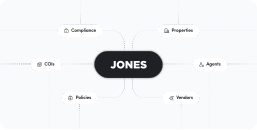
In this guide, we’ll discuss how COIs work, why they matter, and how contractors on both sides — general and subcontractor — can use smarter tools (like Jones) to manage compliance without risking delays, legal exposure, or blown margins.
1. What Is a COI for Contractors — And Why It’s Misunderstood
In construction, risk doesn’t wait. It shows up in subcontractor missteps, accidents on site, delayed claims, and blown deadlines…
What is a Certificate of Insurance?
A COI is a third-party-issued snapshot that summarizes the existence of one or more insurance policies…
What it is not:
- It does not confirm coverage is active, enforceable, or sufficient.
- It doesn’t show exclusions.
- It doesn’t guarantee Additional Insured status.
- It doesn’t alter policy terms.
Why This Misunderstanding Matters
The COI Assumption Trap
- GC receives a COI → looks fine → approves work.
- Work begins.
- Accident occurs → claim filed.
- Insurer denies coverage due to exclusions or lapsed policy.
- GC’s policy or balance sheet takes the hit.
COI ≠ Coverage
2. Who Needs a COI and When: GC vs. Subcontractor Responsibilities
In theory, the roles are simple. In practice? It’s a minefield…
General Contractors
- Define insurance requirements
- Collect COIs + endorsements
- Review/approve coverage
- Track expirations
- Escalate issues before work begins
- Maintain audit trails
Subcontractors
The COI isn’t just paperwork — it’s your gateway to working and getting paid…
- Carry required coverage
- Work with your broker
- Double-check submissions
- Renew early
When Is a COI Required?
- Before project onboarding
- Before contract execution
- Before payment release
- During audits
- At policy renewal
3. Anatomy of a Contractor’s COI: What to Look For
- Insured: Must match contract entity
- Insurance Producer: Broker contact
- Policy Types & Limits: Verify vs. contract
- Effective/Expiration Dates: Prevent lapses
- Additional Insured Language: Must be explicit
- Description of Operations: Watch for vague “as required” phrasing
4. 6 Common Mistakes That Put Contractors at Risk
- Treating the COI as final proof
- Skipping endorsement review
- Not tracking expirations
- Accepting vague “per contract” wording
- Using spreadsheets for tracking
- Letting vendors self-attest
5. How to Request and Review COIs the Right Way
For General Contractors
- Send clear requirements upfront
- Provide sample COIs
- Verify types, dates, endorsements
- Track expirations + automate renewals
For Subcontractors
- Work with broker to meet specs
- Check spelling, limits, names
- Attach endorsements
- Respond quickly to corrections
6. Why Manual COI Tracking Doesn’t Scale
Manual COI tracking breaks fast when you scale…
The Hidden Costs of Manual Tracking
- Staff hours wasted chasing documents
- Increased legal exposure
- Delays in vendor onboarding
- Audit prep chaos
- Premium hikes after denied claims
7. How Jones Streamlines Construction Compliance for GCs and Subs
- Automated COI Collection: Vendor portal uploads
- Policy-Level Verification: Beyond the COI
- Real-Time Dashboards: Track risk + expiring coverage
- Renewal Automation: Never miss a date
- Procore/MRI/CMiC Integrations: Data flows seamlessly
- Audit Trails: Every update logged
8. Final Thoughts: From Risk Exposure to Risk Advantage
COIs are not just a box to check — they’re a risk signal. Treating them strategically is a competitive advantage.
With Jones, you don’t just track documents — you protect your contracts, your timelines, and your bottom line.